How Long Does One IVF Cycle Take? A Complete Timeline Guide

Foods to Eat During Early Pregnancy for Better Breastfeeding
July 25, 2026
Understanding the IVF Process: Step-by-Step Guide to Fertility Treatment
July 29, 2026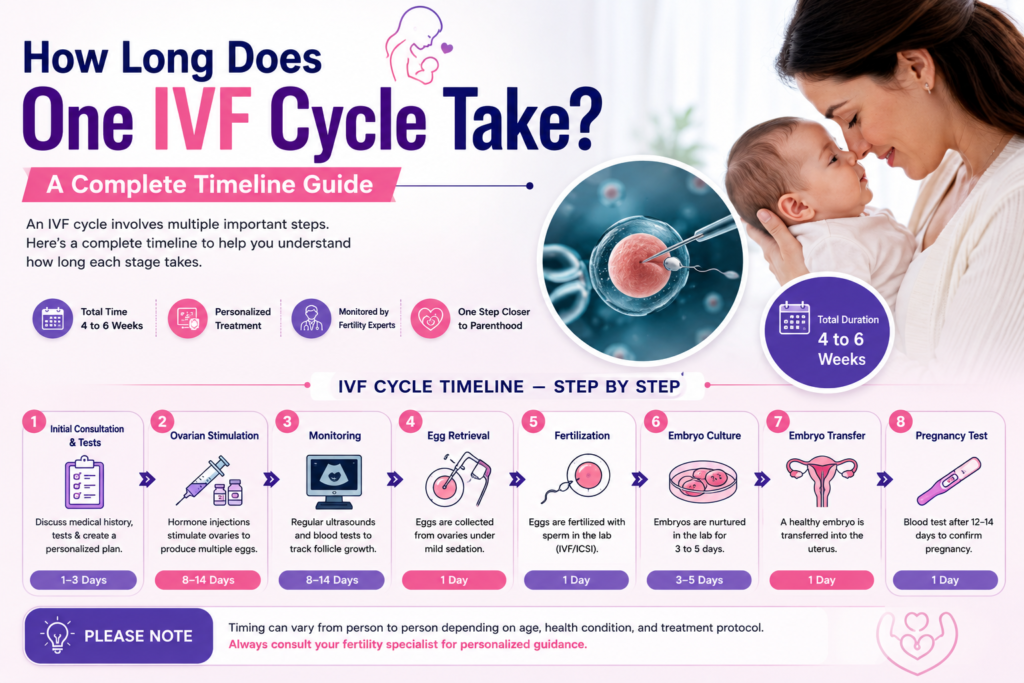
Introduction to the IVF Cycle Timeline
In vitro fertilization (IVF) is a widely used fertility treatment that helps many couples achieve pregnancy when natural conception becomes difficult. One of the most common questions patients ask before starting treatment is, “How long does one IVF cycle take?”
The duration of an IVF cycle can vary depending on individual health conditions, fertility history, and the treatment plan recommended by the fertility specialist. Generally, one IVF cycle may take around 4 to 6 weeks from the beginning of ovarian stimulation to the pregnancy test. Choosing a trusted best ivf center in aligarh can help patients receive proper guidance and personalised care throughout the process. However, the complete treatment timeline may take longer if additional tests, preparation, or frozen embryo transfers are required.
Understanding the IVF cycle timeline can help patients feel more prepared and confident throughout the journey.

READ MORE : Foods to Eat During Early Pregnancy for Better Breastfeeding
What Is an IVF Cycle?
An IVF cycle is a series of medical steps designed to help fertilization happen outside the body. During the process, eggs are collected from the ovaries and combined with sperm in a laboratory. After fertilization, the resulting embryos are monitored and one or more healthy embryos may be transferred into the uterus.
The main stages of an IVF cycle include:
- Ovarian stimulation
- Egg retrieval
- Fertilization and embryo development
- Embryo transfer
- Pregnancy testing
Each stage plays an important role in improving the chances of successful treatment.
Step 1: Initial Consultation and Fertility Testing
Before starting an IVF cycle, patients usually go through an initial consultation with a fertility specialist. This stage helps doctors understand the couple’s fertility condition and create a suitable treatment plan.
The doctor may recommend several tests, including:
- Blood tests to check hormone levels
- Ultrasound examinations
- Ovarian reserve testing
- Semen analysis
- Evaluation of the uterus and fallopian tubes
This preparation phase may take a few days to several weeks depending on the required investigations and reports.
Step 2: Ovarian Stimulation Phase
The ovarian stimulation phase is one of the first major steps in the IVF cycle timeline. During this stage, fertility medications are given to stimulate the ovaries to produce multiple eggs instead of a single egg during a normal menstrual cycle.
This phase usually lasts around 8 to 14 days.
During ovarian stimulation, regular monitoring is required through:
- Ultrasound scans to track follicle growth
- Blood tests to monitor hormone levels
- Medication adjustments based on the body’s response
The goal is to develop multiple mature eggs that can be collected during the next stage.
Step 3: Egg Retrieval Procedure
Once the eggs reach the desired maturity, the doctor schedules the egg retrieval procedure. A trigger injection is given approximately 36 hours before egg collection to help the eggs complete their final development.
Egg retrieval is usually a short procedure that takes about 20 to 30 minutes. It is performed under medication to ensure patient comfort.
After retrieval:
- The collected eggs are sent to the laboratory
- The sperm sample is prepared
- Fertilization begins under controlled conditions
Most patients can return home on the same day after the procedure.
Step 4: Fertilization and Embryo Development
After egg retrieval, the next step is fertilization. The eggs and sperm are combined in the laboratory to create embryos.
In some cases, doctors may recommend Intracytoplasmic Sperm Injection (ICSI), where a single sperm is directly injected into an egg to improve fertilization chances.
Embryos are monitored for several days to evaluate their growth and quality.
During this stage:
- Embryos are observed for development
- The healthiest embryo may be selected for transfer
- Additional embryos may be frozen for future use
Embryo development usually takes around 3 to 5 days after fertilization.
Step 5: Embryo Transfer Procedure
Embryo transfer is an important milestone in the IVF process. During this procedure, a selected embryo is carefully placed into the uterus using a thin catheter.
The procedure is generally quick and does not require surgery.
After embryo transfer:
- Patients may continue prescribed medications
- Normal daily activities can usually be resumed
- Doctors monitor the body’s response
Some patients have a fresh embryo transfer within the same IVF cycle, while others may have a frozen embryo transfer later depending on medical recommendations.

Step 6: Pregnancy Test After IVF
The final stage of the IVF cycle timeline is the pregnancy test. After embryo transfer, patients usually wait around 10 to 14 days before taking a blood pregnancy test.
This waiting period is often considered an emotional part of the IVF journey because patients are eager to know the outcome.
The pregnancy test checks the level of human chorionic gonadotropin (hCG), a hormone produced after implantation.
How Long Does the Complete IVF Process Take?
The complete IVF process timeline depends on the treatment approach and individual circumstances. A typical IVF cycle may take approximately one month, but some patients may require additional time.
A general timeline includes:
- Consultation and testing: Few days to several weeks
- Ovarian stimulation: 8 to 14 days
- Egg retrieval: One day procedure
- Fertilization and embryo growth: 3 to 5 days
- Embryo transfer: Within the same cycle or later
- Pregnancy test: Around 10 to 14 days after transfer
The IVF cycle timeline may differ from person to person based on medical needs.
Factors That Can Affect IVF Cycle Duration
Several factors can influence how long an IVF cycle takes. These include:
- Age of the patient
- Ovarian reserve and egg quality
- Sperm quality
- Response to fertility medications
- Need for additional procedures
- Use of frozen embryos
- Previous IVF history
Some patients may complete treatment quickly, while others may need additional preparation before embryo transfer.
Can IVF Take More Than One Cycle?
Although some couples achieve pregnancy after the first IVF attempt, others may need multiple cycles. Success depends on various factors, including reproductive health, embryo quality, and overall medical conditions.
If the first IVF cycle is unsuccessful, doctors may review the results and suggest changes for the next attempt. Frozen embryos from the first cycle may also be used for future transfers, which can reduce the time needed for another complete stimulation process.
Tips to Prepare for an IVF Cycle
Preparing physically and emotionally can help patients manage the IVF journey more comfortably.
Helpful steps include:
- Follow your doctor’s medication instructions carefully
- Maintain a balanced and nutritious diet
- Avoid smoking and excessive alcohol consumption
- Manage stress through relaxation techniques
- Attend all scheduled monitoring appointments
- Communicate openly with your partner and healthcare team
A positive approach and proper preparation can make the treatment experience smoother.

Conclusion
The answer to “How long does one IVF cycle take?” depends on individual treatment plans, but most IVF cycles take around 4 to 6 weeks from stimulation to pregnancy testing. Understanding each stage of the IVF cycle timeline helps patients know what to expect during this important fertility journey.
Every IVF experience is unique, and working closely with a fertility specialist can provide the best guidance based on personal health conditions and treatment goals. Consulting experienced best gynecologist obstetricians in aligarh can help patients receive expert advice, proper monitoring, and personalised care throughout their IVF journey. With proper planning, monitoring, and medical support, IVF can offer hope to many individuals and couples trying to build their families.